What a superintelligence could do for science
AlphaFold solved in a few years a problem biologists had worked on for half a century. It offers a glimpse of what a much more general intelligence might do to medicine, materials and discovery itself.
Proteins are the machines of life. Each one is a chain of amino acids that folds into a precise three-dimensional shape, and that shape determines what it does: carry oxygen, fight an infection, copy DNA. For fifty years, predicting the shape from the chain was one of the great open problems in biology. Working out a single structure in the lab could take a team months, sometimes years.
In 2020, at a biennial competition called CASP, an AI system from DeepMind called AlphaFold 2 predicted protein structures with accuracy comparable to experimental methods. The organisers, who had run the contest since 1994, said the problem had been largely solved.
Two years later, DeepMind and the European Bioinformatics Institute released predicted structures for over 200 million proteins, nearly every protein known to science, free for anyone to use. In 2024, Demis Hassabis and John Jumper shared the Nobel Prize in Chemistry for the work, alongside David Baker, who had pioneered computational protein design.
It is the clearest example we have of what happens when an AI system is pointed at a hard scientific problem. It is also, almost certainly, a very small preview.
Why AlphaFold is only the beginning
AlphaFold is a narrow system. It does one thing, brilliantly. It does not choose which problem to study, design the experiment, interpret a surprising result, or decide what to do next. Human scientists did all of that.
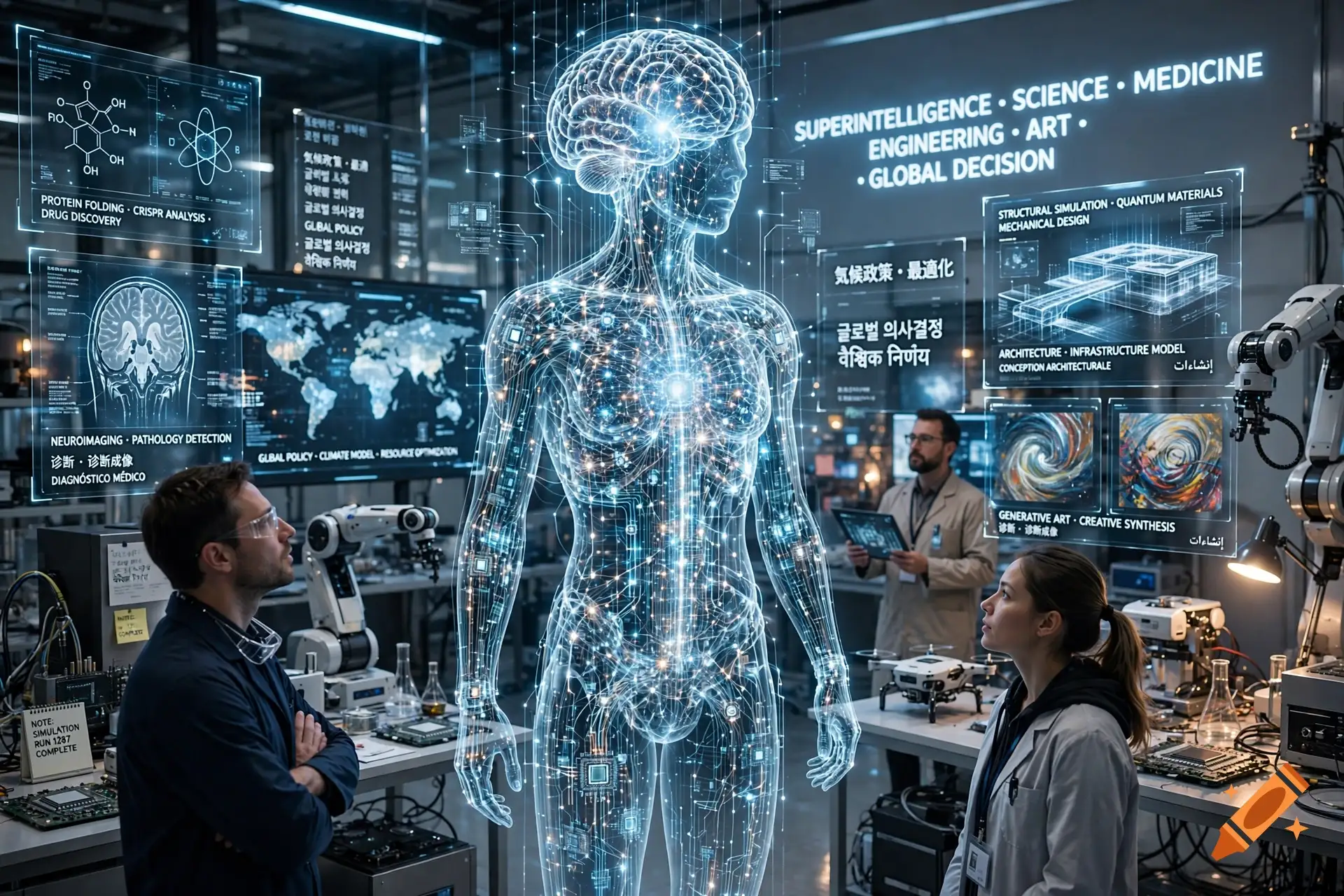
A superintelligence, by definition, would do all of it. It would read every paper in a field, notice the contradiction no one had spotted, propose a hypothesis, design the experiment that tests it, and interpret the results. Then it would do it again, thousands of times in parallel, without sleeping.
We already have hints of what this looks like in narrower forms. In 2020, a team at MIT trained a neural network to recognise antibacterial molecules, then used it to screen thousands of existing compounds. It flagged one that looked nothing like known antibiotics yet killed a wide range of bacteria in the lab. They named it halicin. In 2023, DeepMind reported that its GNoME system had predicted around 2.2 million new crystal structures, of which about 380,000 were thought to be stable. Other researchers later questioned how many of those were truly new or useful, which is itself a useful reminder: prediction is cheap, and verification is where science actually happens.
A compressed century
In a 2024 essay titled Machines of Loving Grace, Dario Amodei, the chief executive of Anthropic, set out an optimistic scenario. Powerful AI, he argued, might compress the progress that biologists would otherwise make in the next fifty to a hundred years into five to ten.
The list of what that could mean is long enough to sound like fiction:
- Most infectious diseases prevented or cured.
- Many cancers turned into manageable conditions.
- Real treatments for Alzheimer’s and other diseases of the ageing brain.
- A far deeper understanding of mental illness, and medicines that work reliably.
Whether any of this happens depends on things we do not know yet. But the logic is not fanciful. A great deal of scientific progress is limited by the number of talented people who can think hard about a problem. Remove that limit, and the pace of discovery could change beyond recognition.
The bottleneck is the physical world
There is a sober counterweight to all this, and it deserves as much attention as the promise.
Thinking is only part of science. A new drug still has to be synthesised, tested on cells, tested in animals, and then tested in people over years of clinical trials. Bringing a new medicine to market often takes a decade or more, and most of that time is not spent thinking. It is spent waiting for biology to show its results, and for regulators to be convinced of safety.
A superintelligence could shorten some of this. It could run better simulations, design smarter trials, and pick candidates far more likely to succeed. It cannot make cells divide faster or patients recover sooner. Some bottlenecks are made of time itself.
A mind a thousand times faster than ours would still have to wait for the experiment to finish.
This is why the most careful optimists talk about acceleration rather than instant transformation. The gains would be real and could be enormous. They would arrive at the speed the physical world allows.
The part we must not forget
Every capability described here has a shadow. A system that can design a molecule to cure a disease can, in principle, design one to cause it. Biologists and AI researchers have both warned that lowering the barrier to advanced biology lowers it for everyone, including people who want to do harm. Most frontier AI labs now test their models specifically for this kind of risk before release.
That tension runs through everything written about superintelligence. The same capabilities that make it the most promising technology we could build are the ones that make it dangerous. Science is where the promise is easiest to see.
The next article in this series looks at a more immediate consequence, one that will reach almost everyone long before the Nobel prizes do: what happens to work.